The allure of ice giant planets like Uranus and Neptune has long captivated astronomers and planetary scientists. These distant worlds, shrouded in mystery, present a unique opportunity to explore the extremes of matter under conditions vastly different from those found on Earth. As our observational capabilities improve and theoretical models evolve, understanding the internal dynamics of these ice giants is more critical than ever. Recent findings suggest that these planets may host a previously unobserved state of matter, which not only challenges our current models but also holds implications for our understanding of planetary formation and evolution in the cosmos.
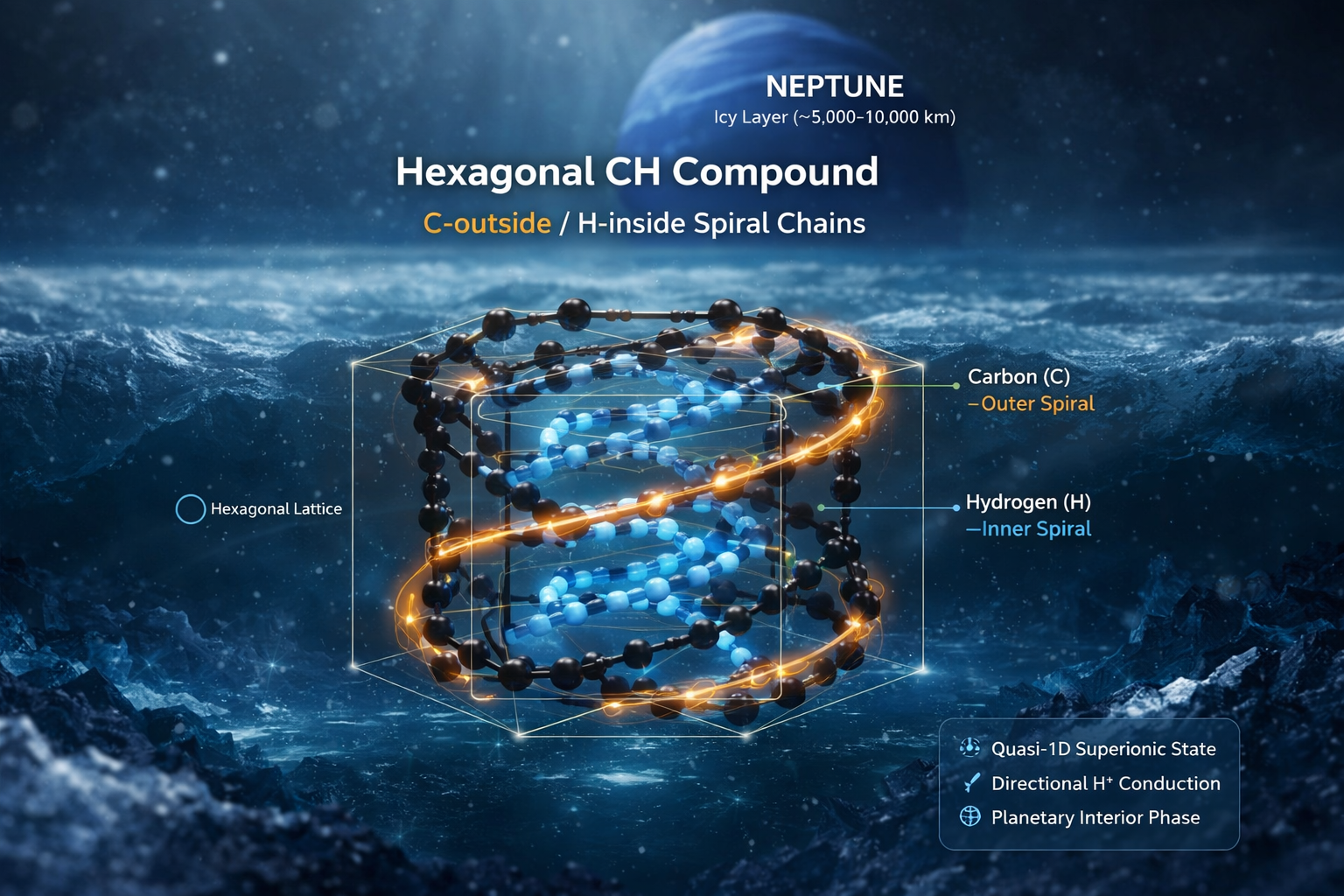
A team of researchers from the Carnegie Institution has published a groundbreaking paper in Nature Communications, detailing the existence of a novel state of matter termed “quasi-1D superionic.” This state is theorized to arise under the extreme pressures and temperatures found in the interiors of ice giants. At depths that can reach millions of times the atmospheric pressure experienced on Earth, and temperatures soaring into the thousands of degrees Celsius, conventional states of matter as we know them undergo radical transformations. The implications of such a discovery are profound, as they may redefine our understanding of the physical properties of materials in these alien environments.
The research team, led by Cong Liu, utilized advanced computational simulations to predict the stability of this quasi-1D phase. Their models indicate that under the right conditions, hydrogen and other compounds could exhibit a unique arrangement of atoms that allows for unusual conductivity and phase behavior. This superionic state is characterized by one-dimensional ionic movement within a lattice structure, which could explain various phenomena observed in the magnetic and thermal properties of ice giants. The potential for superionic materials to conduct electricity while maintaining a solid form introduces a new frontier in material science and planetary physics.
Understanding the quasi-1D state not only enhances our knowledge of Uranus and Neptune but also provides a clearer perspective on the formation of planetary systems across the universe. Ice giants are thought to contain a significant amount of water and other compounds, which may exist in forms not observable on Earth. As we delve deeper into the study of these planets, we may uncover the complex interplay of forces that govern the formation of planetary atmospheres and interiors. This research shines a light on the broader implications of planetary science, linking the mysterious behaviors of distant worlds to the fundamental principles that govern matter itself.
This discovery fits into a larger narrative in astrophysics where the study of exoplanets and their unique atmospheric and internal conditions is becoming increasingly important. The quest to understand superionic states and other exotic phases of matter is pivotal not only for ice giants but also for potentially habitable exoplanets. As we push the boundaries of our observational techniques and theoretical frameworks, the findings related to these ice giants serve as a reminder of the intricacies of our universe and the many secrets it still holds.
CuraFeed Take: The identification of the “quasi-1D superionic” state of matter could revolutionize our understanding of planetary interiors, especially for ice giants. This research underscores the dynamic nature of matter under extreme conditions, suggesting that our current models of planetary formation may require re-evaluation. As we continue to explore the mysteries of our solar system and beyond, watching how these findings influence future missions to Uranus and Neptune will be essential. The excitement generated by such discoveries not only fuels scientific inquiry but also inspires the next generation of astrophysicists to unravel the complexities of the cosmos.