The cosmos is an enigmatic expanse, a domain that challenges our understanding and ignites our curiosity. As astrophysicists, we are dedicated to unraveling its mysteries, yet our exploration is often constrained by the limitations of our observational reach and the sheer scale of the universe. Now, however, we stand on the brink of a transformative era in cosmological research, thanks to an extraordinary new dataset that promises to deepen our insights into the universe's formation and evolution.
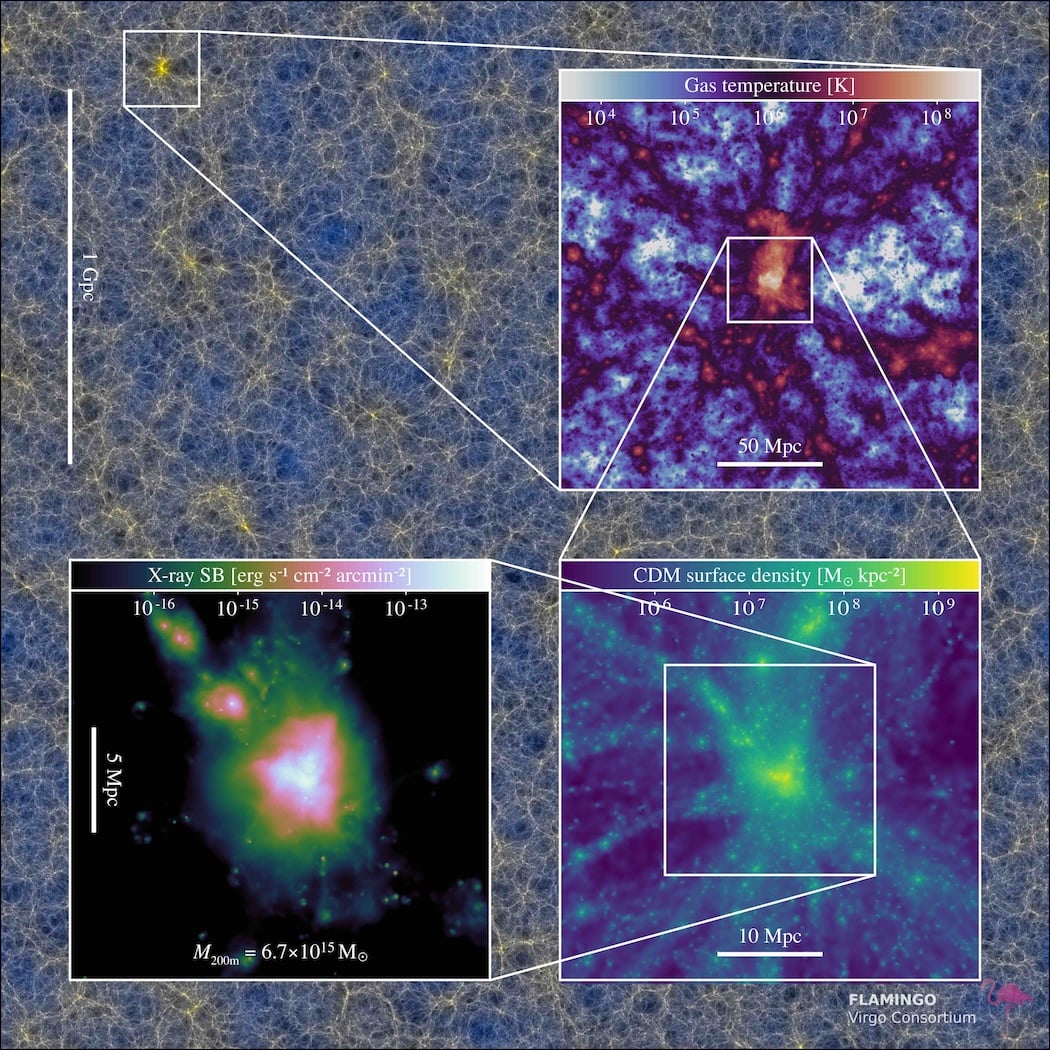
Recently, an international team of astrophysicists announced the release of a groundbreaking dataset, one of the largest ever assembled in the field of cosmology. This dataset, totaling a staggering 2.5 petabytes, is not merely a collection of numbers and figures; it represents a meticulously crafted simulation of the universe's evolution, produced through the innovative FLAMINGO (Fast Lattice Algorithm for Modelling Intergalactic Observations) framework. This sophisticated suite of simulations harnessed the power of supercomputing to model the complex interactions of matter since the Big Bang, detailing the formation of galaxies, the development of cosmic structures, and the intricate web of dark matter that binds it all together.
The FLAMINGO simulations are remarkable not only for their size but also for their detail. They provide a comprehensive view of the universe, tracing the evolution of matter and energy across vast expanses and timescales. By integrating a wide array of physical processes—from stellar formation to gravitational interactions—this dataset allows researchers to explore how the universe has evolved over billions of years. Scholars and scientists can now access this wealth of information, paving the way for new research initiatives and collaborative projects across the globe.
This release comes at a pivotal moment in astrophysics. As we stand on the threshold of new observational technologies, such as the James Webb Space Telescope and the upcoming Vera C. Rubin Observatory, there is an urgent need for robust theoretical frameworks to interpret the data these instruments will generate. The FLAMINGO dataset serves as a vital tool for calibrating our models and understanding the myriad phenomena we observe in the cosmos. It provides a playground for researchers to test hypotheses, validate theories, and ultimately refine our understanding of the universe.
Moreover, as we grapple with the elusive nature of dark matter and dark energy—two of the most profound mysteries in modern astrophysics—datasets like FLAMINGO are invaluable. They enable scientists to simulate various scenarios and examine the role of dark matter in the formation of large-scale structures, thereby enhancing our grasp of its influence on cosmic evolution. With the release of this dataset, the astrophysical community is equipped with a powerful resource to tackle these fundamental questions.
CuraFeed Take: The unveiling of the FLAMINGO dataset signifies a revolutionary step in cosmological research, offering both opportunities and challenges. As researchers worldwide delve into this extensive resource, we can expect a surge of innovative studies and collaborative efforts that may redefine our understanding of the universe. However, the sheer volume of data also presents a challenge—how will scientists sift through, analyze, and derive meaningful conclusions from such an immense dataset? Moving forward, it will be essential to foster interdisciplinary collaboration, integrating expertise from computational astrophysics, data science, and observational astronomy to fully harness the potential of this remarkable simulation. The next frontier in astrophysics is not just about observation; it’s about the intelligent interpretation of the vast data landscape we are beginning to navigate.