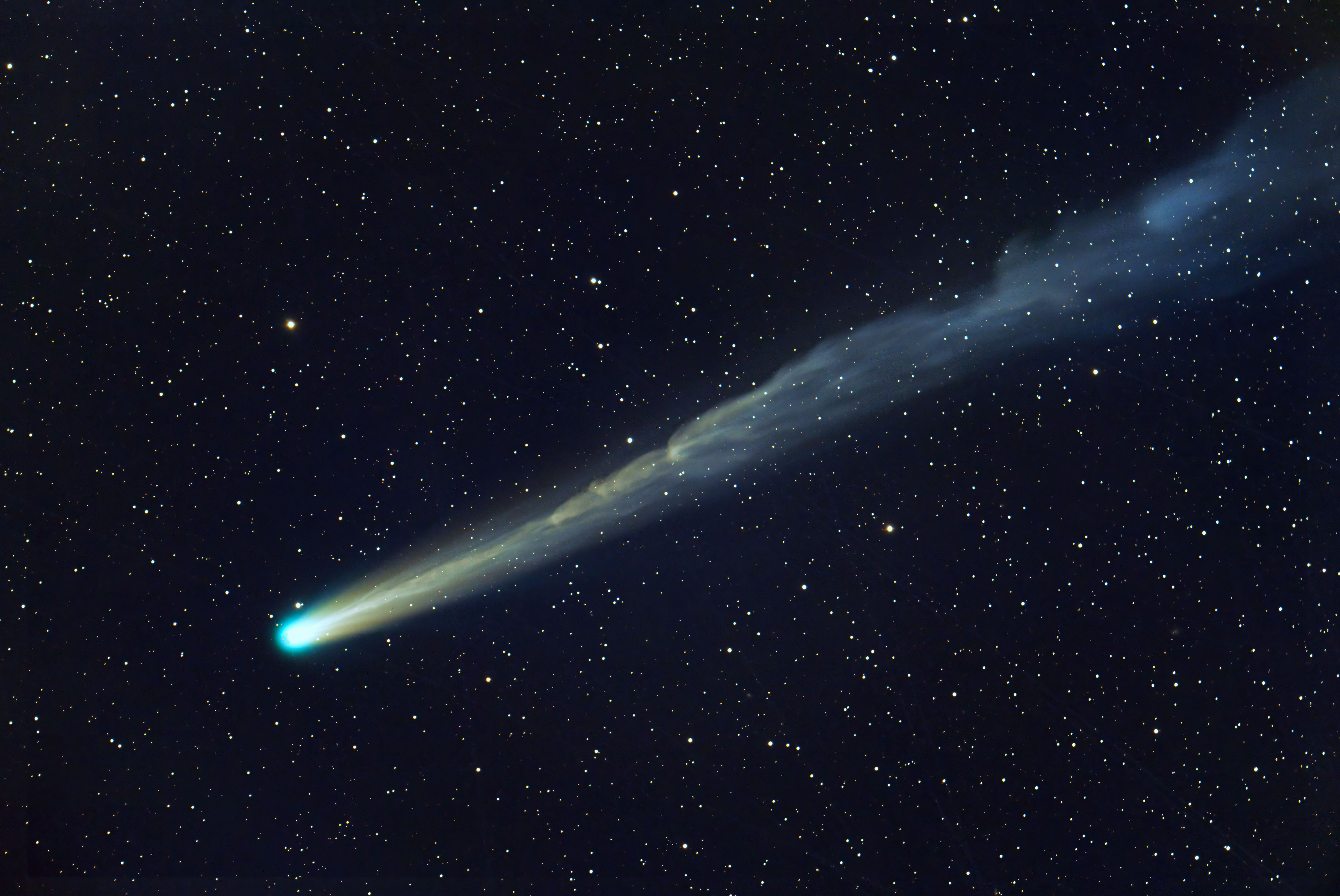
The recent appearance of Comet PanSTARRS has illuminated the twilight skies with an awe-inspiring spectacle that has astrophysics enthusiasts buzzing. On April 18, the comet's ion tail exhibited a smoky, billowing appearance, a visual treat likely influenced by a nearby solar storm. As the comet approached its perihelion, it served as a timely reminder of the complex interactions between solar wind and cometary materials, drawing attention to the importance of observational astronomy in understanding these celestial phenomena.
Photographer Allen Hwang, based in Deming, New Mexico, captured this breathtaking display using an 11-inch RASA telescope, employing a 7.5-minute exposure to reveal the comet's dynamic structure. This technique allowed for the detailed imaging of the ion tail, which is primarily composed of charged particles released from the comet as it nears the Sun. The interaction of these particles with solar wind creates a unique and often unpredictable tail morphology, furthering our understanding of cometary dynamics and solar interactions.
Comet PanSTARRS, designated C/2023 A2, has been a focus of interest since its discovery due to its potential to reveal insights into the early solar system's conditions. The current display of its ion tail, especially in the context of solar activity, underscores the significance of interdisciplinary studies combining astrophysics, solar physics, and observational techniques. As solar storms impact the comet's tail, they provide valuable data that can enhance models of both cometary behavior and solar wind interactions.
This event comes at a pivotal moment in the astrophysics community, where the investigation of solar influences on celestial bodies is gaining momentum. The detailed observations of Comet PanSTARRS can be compared to previous studies of other comets affected by solar activity, facilitating a broader understanding of how these interactions shape the evolution of comets over time.
CuraFeed Take: The mesmerizing display of Comet PanSTARRS not only serves as a feast for the eyes but also as an opportunity for the scientific community to deepen its understanding of the solar system's dynamics. Observers and researchers must continue to monitor such events, as they hold the key to unraveling the intricacies of cometary behavior and solar interactions. As we look ahead, upcoming missions and observational campaigns will undoubtedly seek to capitalize on this momentum, potentially revealing new insights into the life cycles of comets and their role in the solar system's history.