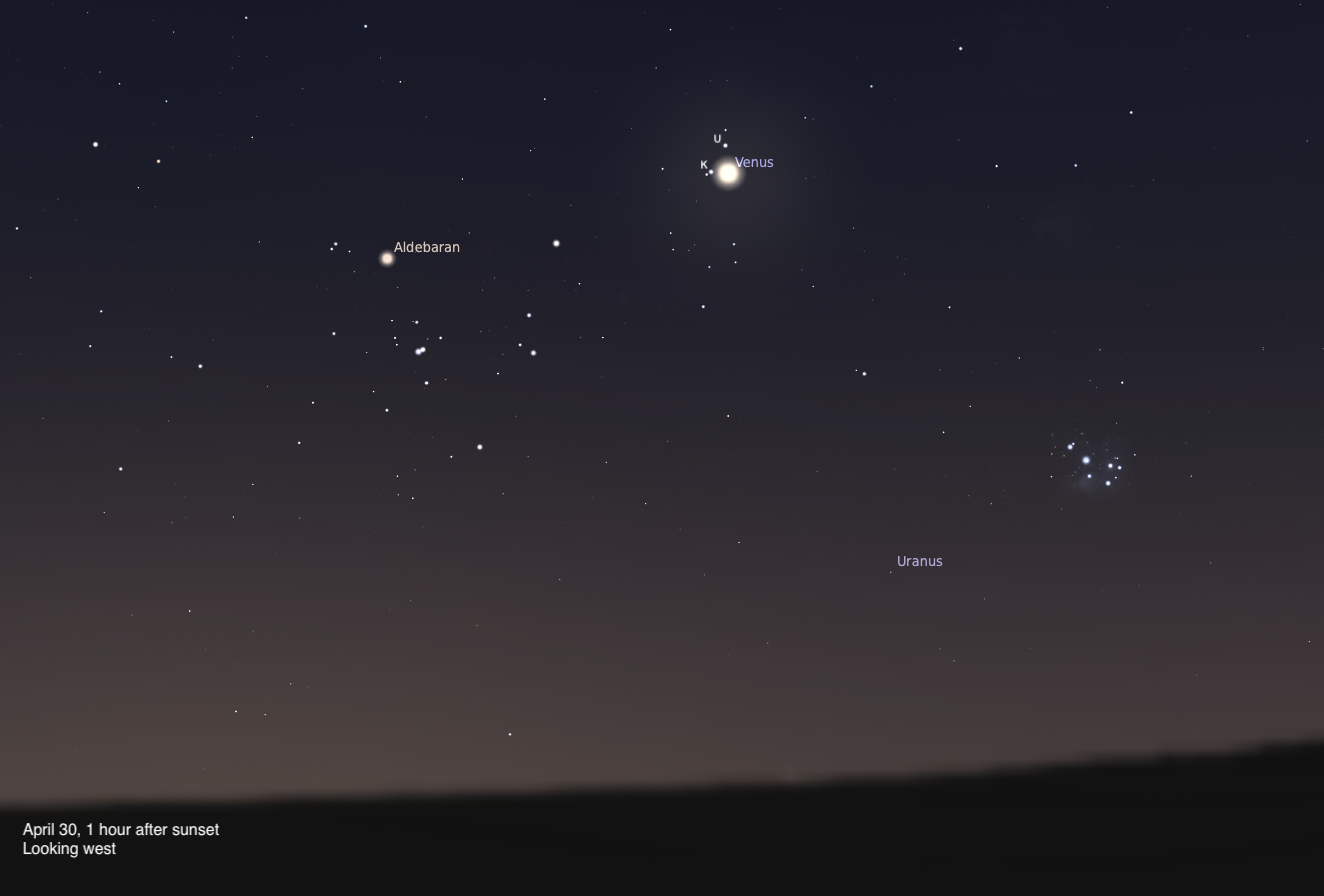
The cosmos has an uncanny way of captivating our attention, especially during moments when celestial bodies align in breathtaking formations. As we approach the end of April, amateur astronomers and seasoned astrophysicists alike are treated to a spectacular sight: Venus, the brilliant evening star, is currently poised near a pair of fourth-magnitude stars, Kappa (κ) and Upsilon (υ) Tauri, in the rich tapestry of the Taurus constellation. Observing these celestial events is not just a pastime; it serves as a crucial reminder of the intricate workings of our universe and the ongoing dance of the planets and stars that occupy it.
On April 29, observers were able to witness Jupiter moving into alignment with Wasat, while Venus continues its journey through the night sky. The positioning of Venus is particularly noteworthy, as it now shines prominently to the upper right of the iconic first-magnitude star Aldebaran, the eye of Taurus, which has long been a focal point for both navigation and mythology. This celestial arrangement, while aesthetically pleasing, also provides valuable insights into the gravitational influences and orbital dynamics that govern the motions of these celestial bodies. As Venus and Aldebaran share the sky, they remind us of the complex gravitational interactions that shape their paths through space.
Such celestial events are more than just pretty sights; they are opportunities to engage with the broader scientific community. The alignment of Venus with Kappa and Upsilon Tauri can inspire discussions about the nature of planetary atmospheres, the potential for exoplanet exploration, and the impact of stellar phenomena on planetary systems. As we observe these interactions, we are reminded of the vastness of the universe and the myriad of processes that govern its behavior, inviting both enthusiasts and experts to delve deeper into the mysteries of the cosmos.
In the context of modern astronomy, these displays of celestial mechanics highlight the importance of our observational tools and methodologies. With advancements in telescope technology and imaging techniques, we are better equipped than ever to study the dynamic relationships between celestial bodies. The ability to observe Venus in conjunction with Kappa and Upsilon Tauri not only enriches our understanding of the solar system but also emphasizes the interconnectedness of all astronomical phenomena. Each observation contributes to a larger narrative, one that encompasses the life cycles of stars, the formation of planetary systems, and the enigmatic nature of dark matter that binds it all together.
CuraFeed Take: This week's celestial event not only serves as a visual reminder of the beauty of our universe but also as a beacon for scientific inquiry. As Venus interacts with the stars of Taurus, we are reminded of the ongoing need for research and exploration in astrophysics. With the rapidly evolving landscape of exoplanet discovery and dark matter studies, these moments in the sky challenge us to think critically about our place in the cosmos and the forces that govern it. Keep your telescopes at the ready, as upcoming weeks promise more stellar alignments and opportunities to deepen our understanding of the universe's intricate dance.