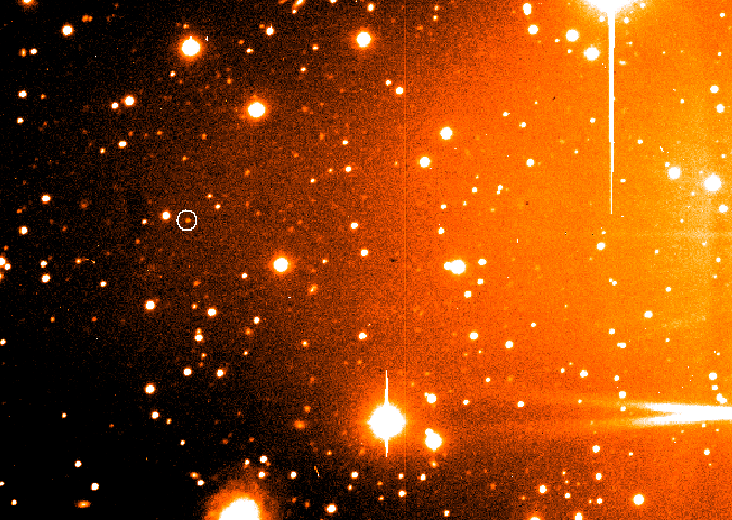
The discovery of two new moons orbiting Uranus, Caliban and Sycorax, marks a pivotal moment in the exploration of our solar system. Announced in the journal Nature on April 30, 1998, these celestial bodies were first detected on September 6, 1997, by a team of astronomers using the advanced capabilities of the 200-inch Hale Telescope at Palomar Observatory. This achievement is not only a testament to astronomical curiosity but also highlights the intricate engineering behind modern telescopic technology. As we stand on the brink of a new era in space exploration, understanding the significance of such discoveries becomes increasingly vital.
The team behind this discovery—Philip Nicholson, Brett Gladman, Joseph Burns, and John Kavelaars—leveraged sophisticated imaging techniques and finely tuned instrumentation to capture the faint reflections of these moons. The Hale Telescope, renowned for its aperture size and imaging resolution, provided the necessary clarity to observe these distant objects. Utilizing advanced light-gathering techniques and adaptive optics, the researchers were able to discern the moons against the backdrop of Uranus' dim light, showcasing the intersection of engineering precision and astronomical observation.
Caliban and Sycorax are not merely additions to the list of Uranian moons; they represent a deeper understanding of the celestial mechanics governing the outer solar system. Their orbits and compositions can provide insight into the formation and evolution of the Uranian system itself. The engineering prowess that facilitated this discovery is a reminder of the complex systems—both mechanical and computational—that underpin modern astronomy. From the design of optical systems to the algorithms that process astronomical data, engineers play a crucial role in expanding the boundaries of our knowledge.
In the broader context, this discovery aligns with ongoing advancements in the field of artificial intelligence (AI) and machine learning, which are increasingly being integrated into space exploration. AI algorithms are now capable of sifting through massive datasets generated by telescopes and spacecraft, identifying patterns and potentially uncovering new celestial bodies that would otherwise remain unnoticed. The intersection of AI with traditional engineering methodologies heralds a new age of discovery that is transforming our approach to space science.
CuraFeed Take: The discovery of Caliban and Sycorax is not just a chapter in the history of astronomy; it serves as a case study in the confluence of engineering, technology, and scientific inquiry. As we continue to push the boundaries of our understanding of the solar system, the integration of AI into engineering processes will be pivotal. Stakeholders in the aerospace industry should watch for the next generation of telescopes and observational technologies that will leverage AI to enhance our explorations, potentially leading to even more significant discoveries in the years to come. The winners will be the engineers and astronomers who harness these technologies, while those who fail to adapt may find themselves left behind in the rapidly evolving landscape of space exploration.