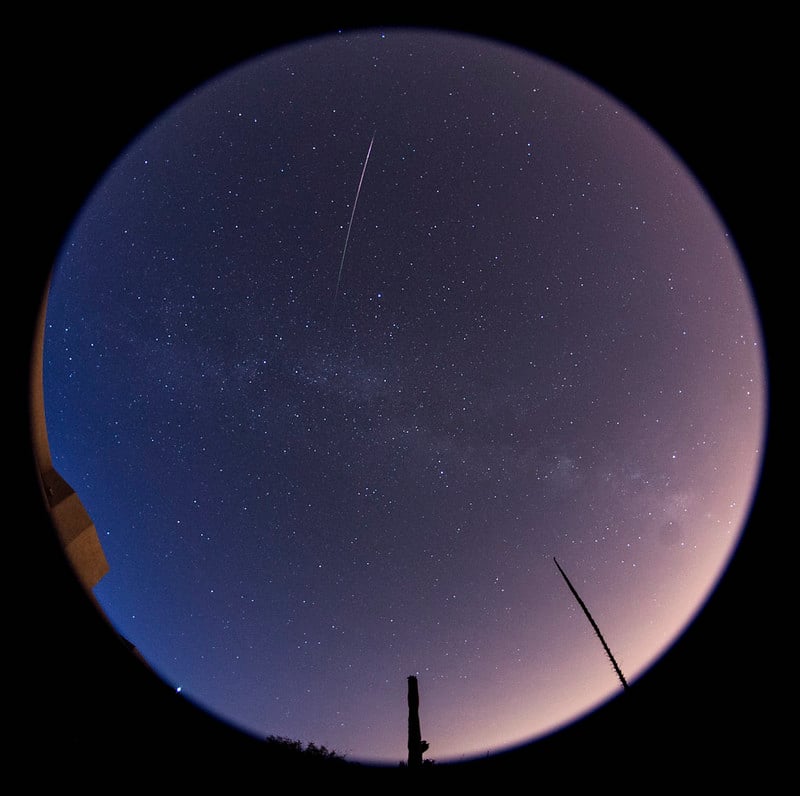
The Eta Aquariid meteor shower, a celestial phenomenon rooted in the debris trail of Halley's Comet, is fast approaching and presents an intriguing opportunity for aerospace engineers to observe the intricate dynamics of meteoroid entry and atmospheric interaction. Scheduled to peak between the evening of May 5th and the morning of May 6th, this event is not only a visual spectacle but also a rich source of data that can inform our understanding of spacecraft materials, thermal protection systems, and the behavior of particles in a planetary atmosphere.
Active from April 19th to May 28th, the Eta Aquariids are renowned for producing up to 50 meteors per hour under optimal conditions. The meteors originate from a variety of sizes and compositions, with many originating from the debris left behind by Halley's Comet. As these particles enter the Earth’s atmosphere at speeds exceeding 66 kilometers per second, they generate intense friction and heat, leading to their incandescence. This provides an excellent real-world example of the principles of aerodynamics and thermodynamics that engineers must consider when designing spacecraft capable of withstanding similar extreme conditions.
For those in the aerospace sector, observing meteor showers like the Eta Aquariids can yield practical insights. The study of these meteors—specifically their trajectories, fragmentation, and energy dissipation—can inform the design of robust thermal protection systems for spacecraft re-entry, as well as enhance our understanding of the risks posed by micrometeoroids to satellites and other space infrastructure. Furthermore, the nature of these meteoroids, including their composition and velocity, can assist engineers in refining propulsion systems that are resilient to impacts from these high-velocity particles.
In the broader context of space exploration and research, the Eta Aquariid meteor shower is emblematic of the ongoing pursuit of knowledge regarding our solar system. As we advance in technologies such as satellite instrumentation and remote sensing, the data collected during meteor showers can enhance our understanding of planetary defense, asteroid impacts, and the origins of our solar system. These insights are vital as humanity prepares for more ambitious missions, including crewed missions to Mars and beyond, where understanding the space environment becomes critical.
CuraFeed Take: The upcoming Eta Aquariid meteor shower represents more than just an astronomical event; it’s a reminder of the inherent challenges and opportunities that lie in the realm of aerospace engineering. As engineers and scientists continue to refine their models and technologies, observing such phenomena can reveal gaps in our knowledge and drive innovation in spacecraft design and protective measures. As we look to the future, keep an eye on the increasing role of observational data from events like these in shaping our approach to space exploration, and consider how current missions might leverage these insights to enhance safety and performance in our quest beyond Earth's atmosphere.